

 24/7
 AdBlue
 Diesel
 Gas Oil
 HGV Access
 HVO
 Lube Oil
 Petrol
 Shop






HVO fuel can be used as a direct replacement for almost any vehicle which currently runs on regular diesel.
There is no need to modify engines or change other aspects of your vehicle. You can just fill up and go. But it’s always best to check with your engine manufacturer first.
HVO fuel is a second-generation, renewable diesel alternative that eliminates up to 90% of net CO2 and significantly reduces nitrogen oxide (NOx), particulate matter (PM) and carbon monoxide (CO) emissions.
As a paraffinic, renewable fuel, HVO can be used as a drop-in alternative to fossil diesel, meeting EN 15940 standards and Fuel Quality Directive 2009/30/EC Annex II. There’s no need to modify existing infrastructure – so HVO can be adapted by motorists who currently use diesel to fuel their vehicles.
Yes, it is safe to mix HVO with regular diesel at any ratio, so there is no need to drain your tank before filling up.
However, for best results and in order to achieve the full extent of carbon emission reduction associated with HVO, it is best to start fueling up with HVO on an empty tank.
In terms of price per litre, HVO fuel does tend to have have a premium over regular diesel, however, it offers up to 90% reduced net CO2 emissions without the cost of changing hardware.
So in terms of transitioning away from fossil fuels, the cost of making the change is minimal when compared to switching to electric or hybrid power.
HVO (Hydrotreated Vegetable Oil) is a renewable diesel made by hydrotreating vegetable oils, used cooking oils, and excess plant matter. The feedstock is first purified to remove impurities and then processed with hydrogen at high temperatures (300–400°C) to eliminate oxygen, converting it into stable hydrocarbons. This process improves fuel quality, enhancing its cold-weather performance, storage life, and overall efficiency.
Unlike traditional biodiesel (FAME), HVO has a higher cetane number, fewer impurities, and does not degrade over time. It is a high-quality drop-in diesel that can be used in existing diesel engines without modifications, significantly reducing CO₂ emissions—by up to 90%—compared to fossil diesel while offering superior combustion properties and engine performance.
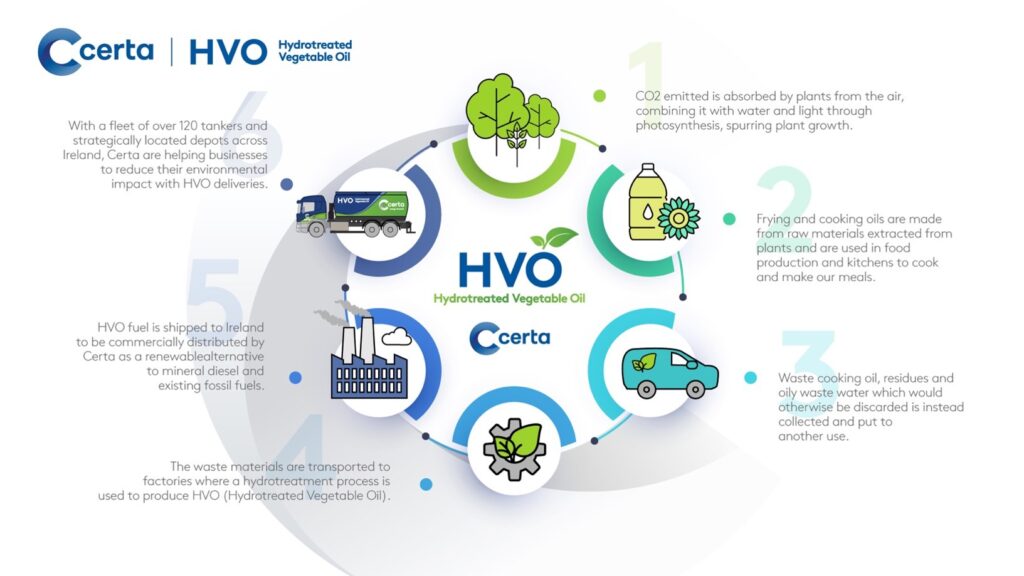
A second-generation biofuel is a fuel produced from non-food biomass, such as agricultural waste, forestry residues, algae, or used cooking oils, rather than directly from food crops like corn or sugarcane.
These biofuels are designed to be more sustainable than first-generation biofuels, which compete with food production. Second-generation biofuels, including HVO (Hydrotreated Vegetable Oil), cellulosic ethanol, and Fischer-Tropsch biodiesel, typically have lower carbon footprints and do not contribute to deforestation or food shortages. They offer improved efficiency, reduced emissions, and better compatibility with existing fuel infrastructure.
In addition to being a drop-in replacement for motorists currently using diesel, HVO fuel has a multitude of commercial applications for a wide range of industries such as construction, haulage, transport, events, agriculture, data centres and much more.
There are many benefits of using HVO fuel, including operational and environmental factors. These include:
- Reduces greenhouse gas emissions by up to 90%
- Meets EN 15940:2016 specifications
- Improve your corporate and social responsibility with Certa HVO fuel
- Extended 10-year storage lifespan with a reduced need for regular testing
- A renewable, sustainable replacement for regular diesel and gas oil
- All deliveries are carbon offset – at no extra cost to you
- Year-round performance
- Tested and tried product; it’s clean, safe and endorsed by a wide range of OEMs
- Excellent cold-weather performance
- Zero FAME, sulphur and fossil content
- Free from aromatics, sulphur and metals
- Reduced particulate production during combustion reduces the ageing of engine oils
- Cleaner and greener air
- Fully biodegradable, sustainable and non-toxic
Yes, absolutely! The similarities between mineral diesel and HVO mean that it can be used as a drop-in replacement for diesel vehicles. But it’s always best to check with your engine manufacturer first.
HVO fuel has OEM approvals from a wide range of manufacturers for a wide range of diesel engines. An OEM approval means that the fuel can be used with no risk of voiding the warranty of the vehicle or machinery.
Please consult the below list of manufacturers that have approved the use of HVO fuel in their engines to see if your hardware is covered. If your engine manufacturer is not included, give us a call and we will be able to contact the provider to determine whether your engine can use HVO. Many vehicle handbooks are now outdated so may not include HVO approvals yet, but it’s likely you can use HVO without any issues.
- Passenger car manufacturers approving the use of HVO fuel:
- Citroën
- DS Automobiles
- Ford (for it’s Transit van)
- Mercedes-Benz
- Peugeot
- Renault
- Volvo
Heavy-duty road vehicle manufacturers approving the use of HVO fuel:
- Mercedes-Benz
- DAF
- Iveco
- MAN
- Renault
- Scania
- Volvo Trucks
Non-road vehicle manufacturers approving the use of HVO fuel:
- AGCO
- Caterpillar
- John Deere
- Scania
- Steyr
Diesel engine manufacturers approving the use of HVO fuel:
- Daimler
- Deutz
- FPT
- ISUZU
- MTU
- Perkins
- Scania
- Volvo Penta